Privacy & Security / Case study
TraceKill
Find where your personal data is being sold, then get it taken down
In short
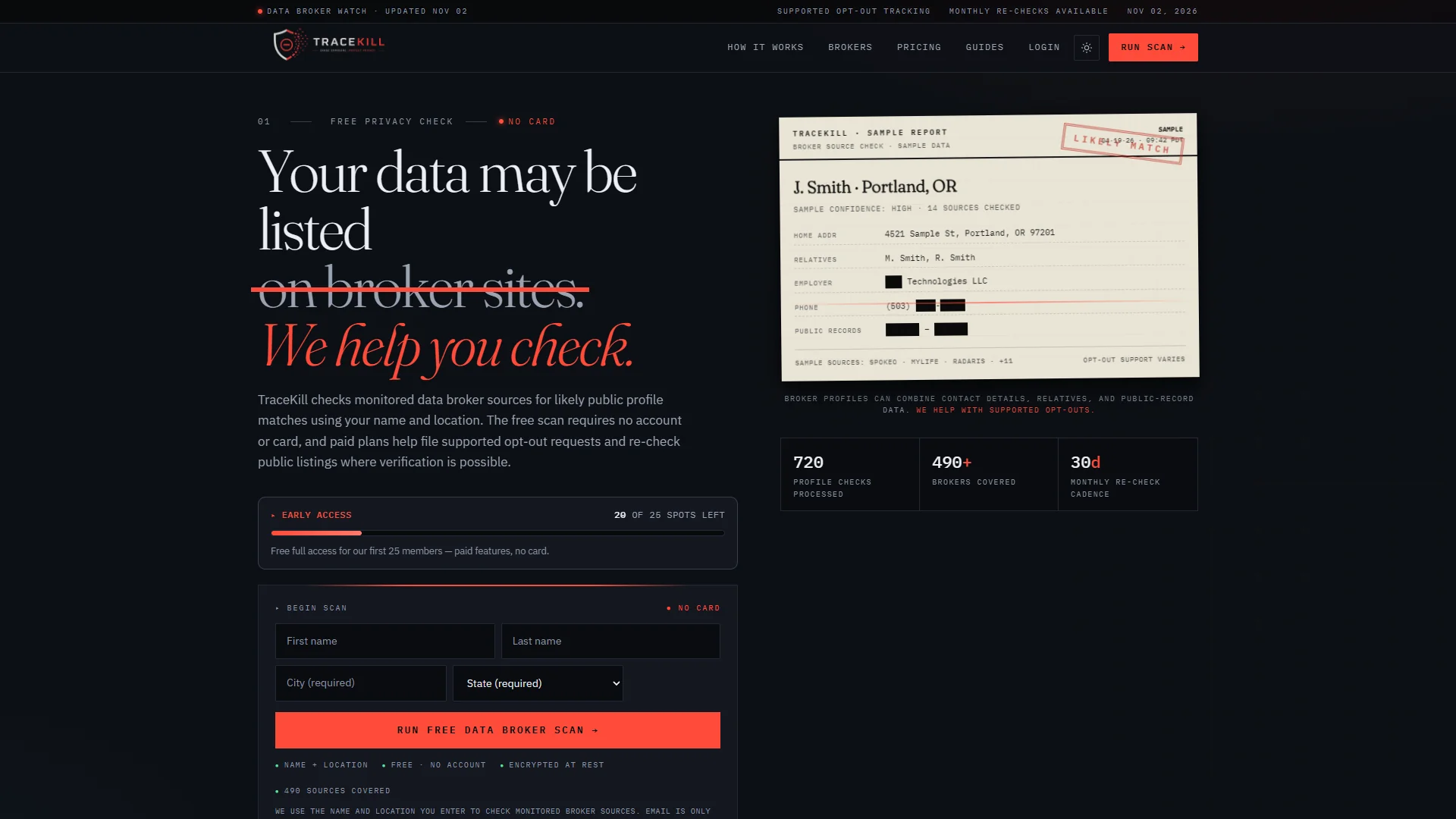
TraceKill is a live privacy SaaS: a free scan shows where someone's personal data is listed across hundreds of broker sites, then removals are filed, tracked and re-checked.
ResultLive at tracekill.com, scanning hundreds of broker sources and re-checking for listings that return.
- Status
- Live
- State
- Live
- Sources
- Hundreds of brokers
- Monitoring
- Continuous re-checks
- Built with
- Elixir / Phoenix / PostgreSQL
Inside the project
01 / 01Live capture from tracekill.com, November 2026.
The brief
The problem
Data brokers publish and sell home addresses, phone numbers and relatives' names. Getting off them by hand means finding every listing, working through each site's own opt-out process, and starting over when the listing reappears a few months later. Most people give up before the first round is done.
What we did
Our approach
We built TraceKill to do the tedious part. A free public scan shows where someone appears. Removal requests are filed and tracked, and each listing's status stays visible. Scheduled re-checks catch listings that return and queue them for removal again.
Features
What it does
- 01
Start with the exposure
The public scan gives people an entry point into a difficult privacy problem: finding where their information appears on broker sites. The interface turns the discovery step into a focused case file.
- 02
Make progress visible
Removal requests and their current status belong in the same workflow. Live status surfaces help people follow what has been requested and what still needs attention.
- 03
Keep checking after the first removal
Personal data can reappear. Background queues and scheduled checks support follow-up work, so the product is designed around ongoing monitoring as well as the initial scan.
Results
What happened
- Live at tracekill.com with a free public exposure scan
- Covers hundreds of data-broker sources
- Every removal request tracked with a visible status
- Scheduled re-checks catch listings that reappear
Services
What this work shows we do
Custom software
Service pageSoftware built around how the business works, and run after launch.
Business automation
Service pageRepetitive steps moved to code that runs the same way every time.
Related work
Built with the same services
 Developer Tools
JarvisMCP
JarvisMCP gives AI agents one governed door into our company systems: CRM, search intelligence, infrastructure, memory and coordination. Agents find the capability they need, act through it, and leave a record. They never hold the keys.
Read the case study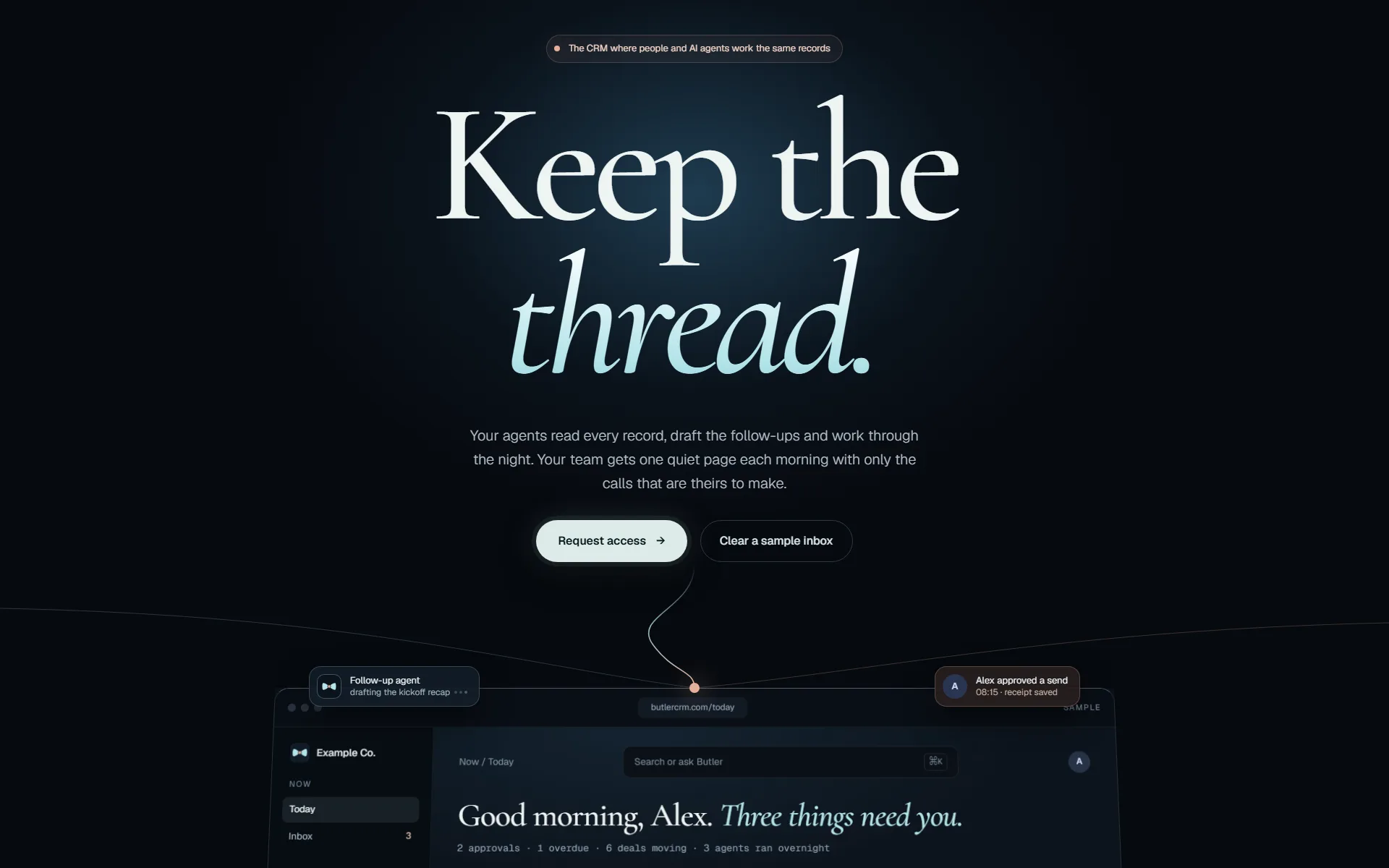 Business Systems
ButlerCRM
ButlerCRM keeps contacts, deals, email, calendar and tasks in one workspace that updates live for everyone in it. We rebuilt it on Elixir/Phoenix so changes appear for the whole team as they happen.
Read the case study
How we work
How a change reaches production
The same five gates for our own products and for yours. Nothing reaches your customers on the strength of a demo.
- 01 · Isolate
Its own branch and workspace
Every change starts in a separate copy of the code, so work in progress never touches what is live.
git worktree add .worktrees/your-change - 02 · Build
Engineers with AI agents
Agents write and test code beside us. They hold no passwords: every call they make goes through our gateway, which checks it and logs it.
agent → gateway → policy · audit · call - 03 · Prove
Evidence, then review
Tests, before-and-after screenshots of the running app, then independent reviewers. It does not move on until no serious finding is left.
review: 0 high · 0 medium → pass - 04 · Ship
Deployed and checked live
The pipeline builds and deploys. Then we check the running service itself, not just a green build.
replicas 1/1 · image sha matches · health 200 - 05 · Watch
Checked every night
Each integration we run is tested against its provider every night, so a changed API is caught before your team notices.
nightly: each integration vs its provider